

Transitioning from legacy applications to modern applications
Recently, I needed to prepare a contract document for one of my clients. I opened Microsoft Word and began typing; however, I was bored during the whole process and wondered if my website couldn’t generate this paper. I needed something that is well-formatted and incorporates my branding, but I didn’t have time to do it all in MS Word.
Consider the following scenario: you need a tax compliance certificate; you log in to itax, generate it, and you’ll have a nicely designed document in no time. What if someone in their workplace had to develop it in MS Word every time someone needed a compliance certificate? Tedious? Isn’t?
We’ve all encountered a complex problem and wondered whether there was a better way to solve it.
As developers, we talk about application modernization in technical terms, but our clients want to know what benefits this will provide.
Sometimes a customer may request that particular features be added to their existing systems, and after completing a system analysis, you discover that the system must be redesigned to satisfy such requests.
The necessity to revamp a system is becoming more common these days, yet our customers are unsure of what we would do differently.
When we say we want to modernize an application, we mean we want to increase the speed with which new features are delivered and enable your application to communicate with other applications.
We begin by performing an application assessment, which involves examining the system’s architecture and determining how critical the application is to the customer experience and your company’s future.
How does a modern application look like?
- Microservices architecture: A microservice is a small application that usually houses one function. The function is exposed through APIs and messaging. Each microservice can have its own DevOps pipeline, scale individually, and have its own database where it owns a data model.
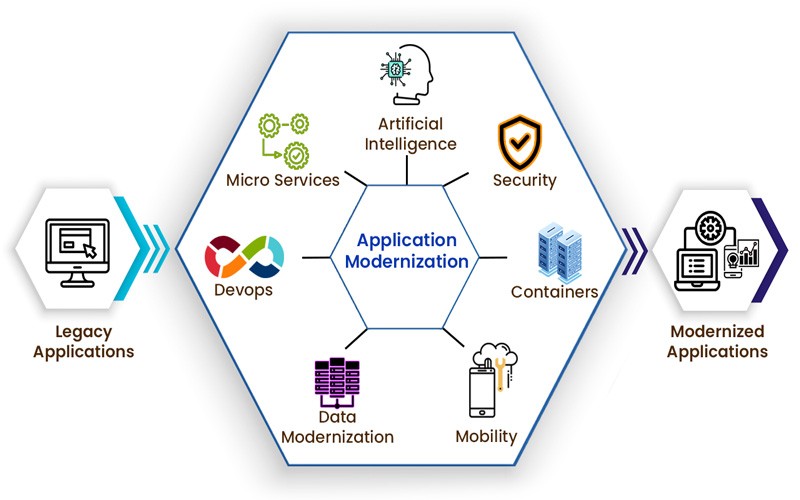
Clients are trying to modernize their applications to keep up with the rate of change… in the past, operations dictated how applications were written… people spent years writing monolithic applications in which a lot of application function was packaged inside the app… now they are seeing the difficulty developers are having in adding new features to respond to changing marketing demand.
- Leverage the power of your programming language’s latest version: Every version, even minor versions, provides performance benefits, including security fixes and other useful extras which increase the versatility and sustainability of your application.
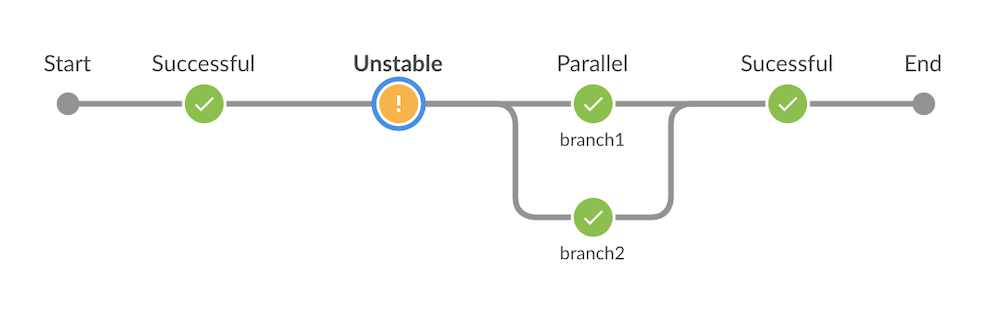
- DevOps experience integrated for all applications: This enables you to achieve elite performance in your software development and delivery. You can use these four-key metrics:
- Deployment Frequency
- Lead Time for Changes
- Time to Restore Services
- Change Failure Rate
- Cloud computing: In cloud computing, the capital investment in building and maintaining data centers is replaced by consuming IT resources as an elastic, utility-like service from a cloud “provider” (including storage, computing, networking, data processing, and analytics, application development, machine learning, and even fully managed services).